

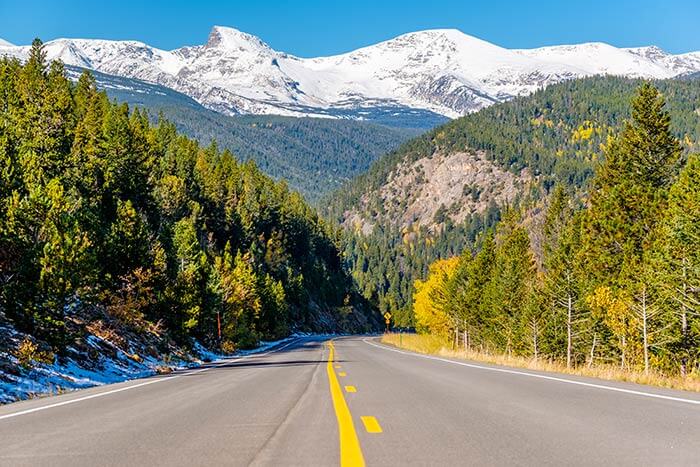
You’re cruising along a Colorado road, heading into the Rockies. First incline, your bike sputters, the throttle lags but recovers. You hit your first switchback, slow it down, drop the revs; the bike hesitates, jolts and lurches forward. You take the corner, but as you come out, your bike stutters, loses power mid rev and struggles forward. You open the throttle. Nothing happens. You open it to the max and the bike lurches. It chugs its way up the mountain.
That’s how your mountain motorbiking trip of a lifetime goes – the whole way.
Your bike performs at peak on the highway and on the dyno, but when you need it at its best, it turns into a piece of trash.
Why? It’s been programmed that way.
As you gear up to take on some of America’s best scenic motorcycle roads, it’s time to take out the trash. Here’s how to override manufacturer settings that cripple your bike’s performance on inclines and at high altitudes. Want the ultimate ride? It’s time to prep your bike for mountain motorbiking.
Woolich is Designed Specifically for Racetrack Performance
Woolich Racing is the top choice for professional motorcycle racers. Our ECU flashing allows you to tune with more precision across more engine systems. Woolich Racing’s precision tuning, especially tuning that removes limiters and adjusts air-fuel ratios, is designed for track use only. We recommend you seek advice around emissions and other applicable local laws before removing speed limiters and adjusting your air fuel ratio if you intend to ride on the street.
Oxygen Levels At High Altitude
There’s less oxygen in the air at any altitude greater than 6900 feet (referred to as partial pressure of oxygen). The higher you go, the less oxygen is in the air you breathe and the air that’s used to power your motorcycle’s engine. Less oxygen to combust means your bike runs rich and becomes ‘sluggish’ – just when you need it at peak performance. If you’re travelling in winter (or in a humid environment), you may find the issues get a whole lot worse due to what’s called ‘Density Altitude.’ This is where very cold temperatures or high humidity make for “denser” air, which worsens your engine’s performance.
You lose approximately 3-5% of your power for every 3280 feet altitude gain. On America’s higher peaks, that is a significant loss.
See Risk Factors For America’s Best Motorcycle Routes
Mountain Riding on a Rich AFR
Same fuel, less oxygen – adds up to a rich mix. Learn more about Air-Fuel Ratio here. Your air-fuel ratio is one of the biggest performance influencers in your bike’s engine. Without adjustments for altitude, you may notice:
- Sluggish throttle response – you’ll likely notice a significant decrease in acceleration, especially on hills and if you’re carrying any kind of load. You may experience lag time in throttle response and “stuttering” while accelerating.
- Poor engine response and loss of top end power – your engine may struggle to build revs, and you may struggle to reach and maintain peak speeds on straights.
- Uneven idling – your bike may be unstable or even stall at low RPMs.
- Overheating or running hot – your bike may overheat, as poor combustion means extra fuel in the combustion chamber. This can heat up your bike.
- Poor fuel efficiency/lower milage/higher emissions – rich air-fuel mixes burn inefficiently, so you’ll burn more fuel to create the same level of output.
- Potential engine issues – if your engine is running hot and rich, you could see further performance problems from spark plug, filter and injector clogging.
- In carburetted engines, you may find yourself in a world of pain – you could see black smoke from your exhaust and experience severe performance issues. You’ll need to re-jet your carburettor to correct it.
But, My Ride is Fuel-Injected?
It’s true that, generally, fuel-injected engines handle high-altitude rides better, but not always. And if you’re after the ride of a lifetime, better isn’t going to cut it. How well your bike adjusts depends on how it’s built and how you’re riding it.
Your bike’s fuel control takes place in its ECU, using a (nearly) real-time sensor called a Lambda sensor. It switches between the two depending on how much power you’re asking for. If everything’s working as it should, your bike will make basic adjustments for lower oxygen levels. Learn more about motorcycle ECU maps and Closed and Open Loop Motorcycle Fuel Control.
How To Prevent Altitude-Related Motorcycle Problems
Altitude Compensation Kits: Some bikes have a barometric sensor built in, feeding back to the ECU – some bikes need an additional kit installed. These measure altitude so the ECU can compensate using a pre-programmed map. This means that changes in real-time can be sluggish, and the bike may need to be flashed to run efficiently with the new kit.
Piggybacked Fuel Management: These add pre-set instructions on top of your bike’s existing pre-set instructions. Chances are your dyno tuner has suggested one of these “plug-and-play” bike optimization systems. They add an extra layer of information to the instructions coming from your ECU to your fuel management system. They help a little – but they work to pre-sets. That’s a problem when the way you ride, the road you’re riding and the real-time experience isn’t pre-set.
Woolich Racing with Autotune: There’s a reason so many champion riders choose Woolich Racing, especially when racing at altitude. Woolich Racing Autotune doesn’t simply add a layer of generic instructions. It gives you the ultimate control over every element of your bike’s performance. It hacks into your motorcycle’s brain and changes the way it thinks in real-time. Woolich is about tuning your bike to its limit of performance. The bike’s performance – and yours.
What’s the Difference Between Woolich Racing and Piggyback Systems?
We’ll demonstrate the difference with a mountain motorbiking scenario. Imagine you’re travelling the Rocky Mountain roads. Your bike has been pre-programmed to cut emissions and conserve fuel, so it tries to switch to fuel economy every time you go down a hill or drop your revs.
What happens next depends on which tuning system you have.
What’s happening when you have a piggyback system?
Your piggyback tuner system tells your bike to stop that – taking the edge off the engine stutters. The engine still limits your throttle response, and it still switches to eco-mode. It still does all the stuff that ruins your ride, but a second later, your plug-and-play system kicks in with a set of generic instructions. By the end of the ride, your bike is HOT. It’s running so dang hot that even after stopping for an hour to grab a bite to eat, it’s still hot. But at least you can keep up with the convoy now.
What’s happening when you have Woolich Racing with Autotune?
None of that nonsense. Woolich Racing overrides the manufacturer’s instructions to switch to eco mode. It removes speed limiters, and lets you decide how many revs you need in real-time. With Woolich, you have total control of the bike’s AFR. It uses your instructions around how and where you ride to give you precision control over every element of your bike’s performance. And the kicker – it costs about the same as the piggyback system.
Do our motorcycle tuning course for free.
Or find a Woolich Certified Dyno Tuner near you.